

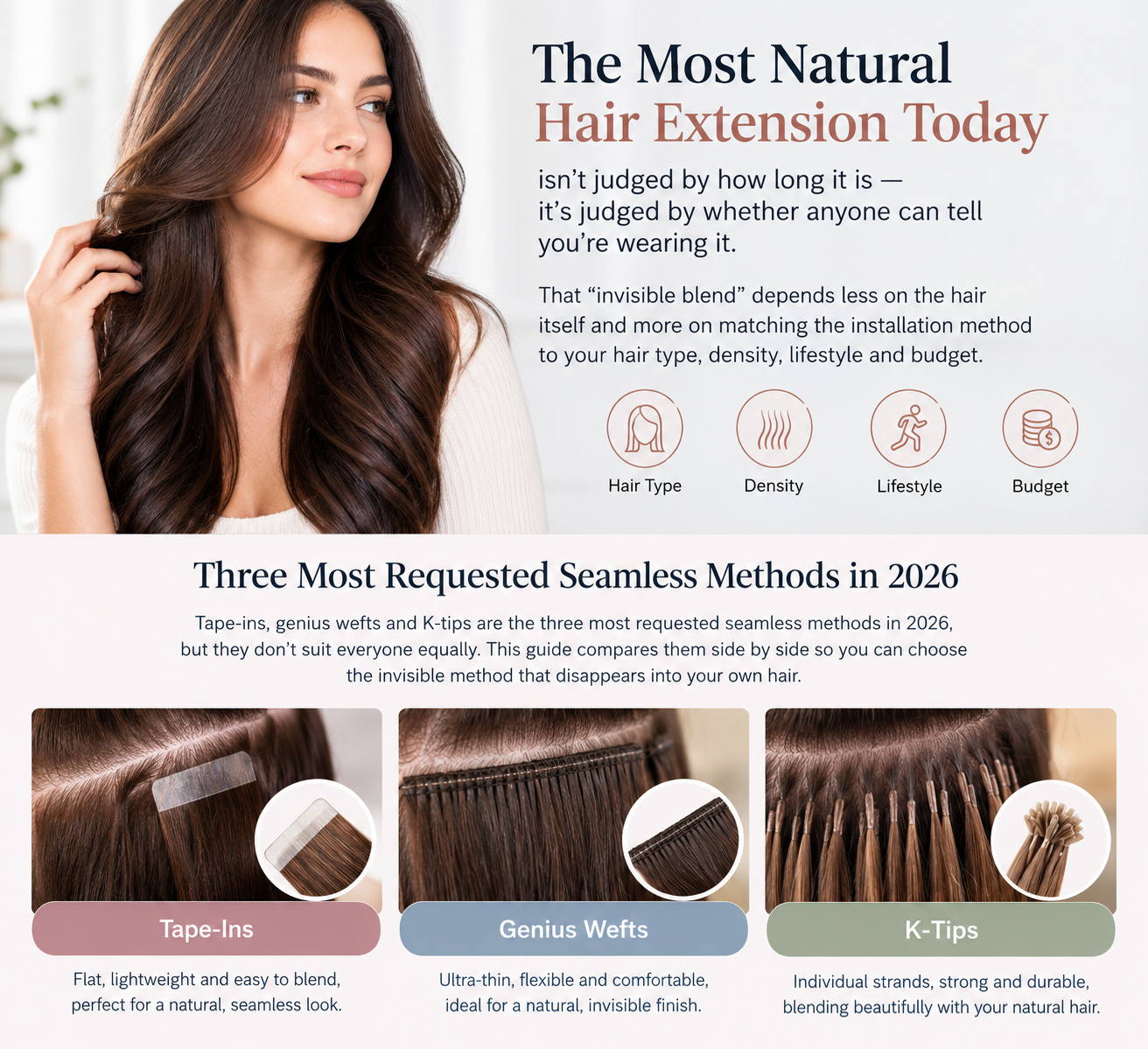
Tape-Ins vs. Genius Wefts vs. K-Tips: Which “Invisible Blend” Is Right for Your Hair Type?
Introduction
Quick Comparison Table
| Feature | Tape-Ins | Genius Wefts | K-Tips (Keratin Fusion) |
|---|---|---|---|
| How it attaches | Adhesive tape sandwich | Sewn into beaded rows | Individual keratin bonds, fused with heat |
| Reinstall / move-up | Every 6–8 weeks | Every 6–8 weeks | Every 3–5 months |
| Hair lifespan (with care) | 8–14 months | 12–18 months | 8–16 months |
| Install time | 1–2 hours | 1.5–3 hours | 2–4 hours |
| Weight on scalp | Very light, distributed | Lightweight rows | Tiny 0.5–0.7g bonds |
| Best hair type | Fine to medium | Medium density, 4+ inches of base hair | Medium to thick |
| Adhesive / heat | Tape only | No adhesive, no heat | Heat during bonding; solvent to remove |
| Styling versatility | Flattest, great updos | Best worn mostly down | Most natural free movement |
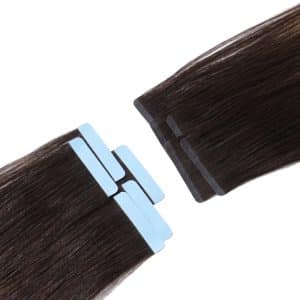


- Tape-In Extensions: The Flat, Fast, Invisible Choice
Tape-ins are thin wefts sandwiched between two layers of your natural hair with medical-grade adhesive tabs. Because the tabs lie completely flat, they are nearly undetectable at the roots and work beautifully for a seamless blend on fine hair.
Best for: fine to medium hair, first-time wearers, busy lifestyles, and anyone who wants a quick 1–2 hour install.
Pros: lightweight, fast to fit, reusable after re-taping, the flattest profile for updos and ponytails, affordable entry point.
Cons: needs re-taping and a move-up every 6–8 weeks; avoid oil-based products near the tabs; poor-quality tape can slip or feel stiff.
Cost: usually the lowest upfront investment; budget for tape replacement at each move-up.
- Genius Wefts: Hand-Tied Volume That Moves Naturally
A genius weft is a ultra-thin, hand-tied weft sewn onto horizontal beaded rows. Because it is sewn, not glued, it adds length and volume with no adhesive residue and sits softly against the scalp.
Best for: medium-density hair with at least 4 inches of natural hair to anchor the rows, clients who want lasting volume and mostly wear their hair down.
Pros: no glue or heat, naturally thickens the root area, hair lasts 9–12 months, comfortable for daily wear.
Cons: requires enough natural hair length; less ideal for very fine or sparse hair; updo styling limited by the rows.
Cost: mid-range; professional sew-in time makes the appointment longer.
- K-Tips (Keratin Fusion): The Individual, Long-Lasting Blend
K-tips are single strands tipped with keratin protein, bonded to small sections of your hair with a heat tool. Each bond moves independently, which is why the result looks and feels like your own hair growing from the scalp.
Best for: medium to thick hair, active lifestyles, and clients who want the longest gap between appointments.
Pros: lasts 3–5 months before a visit, no beads or adhesive tabs, the most natural movement and lightweight feel, suitable for all styling.
Cons: longest install (2–4 hours), bonds require a solvent for removal, not recommended for fragile fine hair that can’t support individual bonds.
Cost: highest upfront due to labor; fewer appointments offset the cost over time.
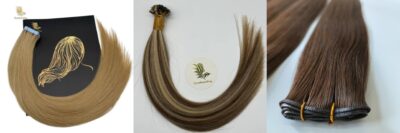
Which Invisible Method Matches Your Hair Type?
- Fine or thin hair → Tape-ins. Wide weight distribution and flat tabs minimize pull; keep total weight light (around 2–3 oz).
- Medium density, want volume and longevity → Genius wefts. Best when you have enough base hair to secure the rows.
- Medium to thick hair, want minimal salon visits → K-tips. Individual bonds give the freest movement and longest wear.
- First-time buyer on a budget → Start with tape-ins; it’s the lowest-commitment way to test extensions.
- Very active, swimming or gym daily → K-tips or well-sealed genius wefts, away from tape that oils and sweat can loosen.
No method hides poor-quality hair. A truly invisible blend starts with 100% Remy human hair that matches your texture and density; synthetic or mixed fiber always shows at the ends.
Simple Aftercare for a Seamless Result
Use sulfate-free, alcohol-free products; avoid oils near tape tabs; brush gently twice daily; and schedule your move-up on time so grown-out bonds never become visible or pull.
Conclusion
Tape-ins win for fine hair and speed, genius wefts win for natural volume on medium hair, and K-tips win for long-lasting movement on thick hair. Match the method to your hair type rather than chasing trends, and the result disappears instead of announcing itself.
At Everbeauting Crafts, we supply 100% Remy human hair in tape-ins, hand-tied wefts and K-tips with flexible MOQ for trial orders. Request a quote or free sample and tell us your hair type, length and color — we’ll match you to the right method.

FAQs
- What are invisible hair extensions?
Invisible extensions are methods that lie flat or bond individually so the attachment point cannot be seen against the scalp. Tape-ins, genius wefts and K-tips are the three most common invisible blends in 2026.
- Are tape-ins good for fine hair?
Yes. Tape-ins are usually the best choice for fine or thin hair because the flat tabs distribute weight widely and pull less than individual bonds.
- How long do tape-ins last between appointments?
Tape-ins need a move-up or re-taping every 6–8 weeks; the hair itself can be reused for 8–14 months with proper care.
- What is a genius weft and how is it different?
A genius weft is a thin hand-tied strand sewn into beaded rows instead of glued, giving natural volume with no adhesive and a lifespan of 9–12 months.
- Can genius wefts work on thin hair?
Only if you have at least 4 inches of natural hair to anchor the rows; on very sparse hair, tape-ins are safer.
- How long do K-tip extensions stay in?
K-tip keratin bonds last 3–5 months before removal or reapplication, the longest interval of the three methods.
- Do K-tips damage hair?
When installed and removed by a professional on suitable hair, properly sized 0.5–1g bonds are low-damage; they are not recommended for fragile fine hair.
Tape-ins have the lowest upfront cost; K-tips cost more per appointment but need fewer visits each year.
- Can you wear updos with all three methods?
Tape-ins are the flattest and easiest to style up; genius wefts are best worn down; K-tips allow the most unrestricted styling.
- What hair quality gives the most invisible blend?
100% Remy human hair matched to your texture and density blends most naturally; synthetic or mixed fiber tends to shine and separate at the ends.