


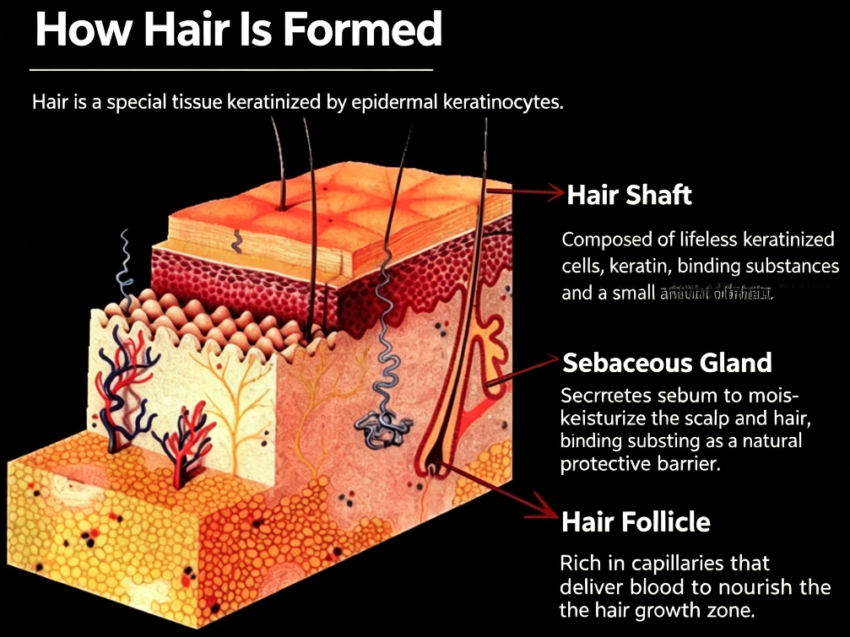
- General Knowledge About Hair
A person can grow approximately one million hairs over the course of their lifetime. Asians typically have about 100,000 to 150,000 strands of hair, whereas Europeans and Africans generally have between 150,000 and 180,000 strands. Each strand grows at a rate of approximately 0.03–0.04 cm per day, or 1–2 cm per month. Individual strands can withstand temperatures of 100°C–120°C. Hair is formed through the hardening and accumulation of the body’s proteins.
Human hair is composed of 17% water, 65% protein, over 2,000 types of DNA, and 18% lipids. Hair itself is not “alive” (technically, the portion beneath the scalp is living, while the portion extending outward is not); consequently, it lacks the ability to self-repair or maintain itself.
Functions of hair include: enhancing appearance and image; framing the face; providing warmth; dissipating heat; offering thermal insulation; and protecting against ultraviolet rays and harmful substances. Regarding hair structure: the cuticle layer accounts for 10% of the hair and determines color translucency and luster;
the cortex accounts for 80% of the hair; and the medulla—also known as the central layer—accounts for 10%, providing structural support and insulation (this layer is absent in fine, soft hair).
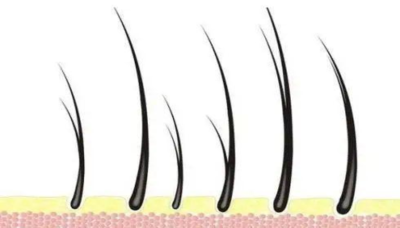
- Structure of Hair:
(I) Hair Growth Cycle
(1) Anagen Phase:
Also known as the active growth phase, this stage can last 4–6 years or even longer. The hair is in a state of active proliferation; cell division accelerates in the lower part of the hair bulb, while cells in the upper part differentiate into the cortex and cuticle. The dermal papilla enlarges, and its cells divide rapidly and increase in number. Previously inactive melanocytes develop dendritic processes and begin to form melanin.
(2) Catagen Phase:
Also known as the regression or involution phase, this stage lasts 2–3 weeks. Active hair proliferation ceases, and a club hair forms; its lower end consists of homogeneous, eosinophilic material, creating a shape resembling a club or baton. The inner root sheath disappears, the outer root sheath gradually keratinizes, and the hair bulb flattens (losing its invaginated shape). The dermal papilla gradually shrinks, and the number of cells decreases. Melanocytes lose their dendritic processes, reverting to a round shape while remaining active.
(3) Telogen (Resting Phase):
Also known as the resting or quiescent phase, this stage lasts approximately three months. During this phase, the hair follicle gradually shrinks while a new anagen hair bulb forms near the aging follicle; eventually, the old hair sheds as a new hair grows, entering the anagen phase and repeating the cycle. On the scalp, 9%–14% of hairs are in the telogen phase and only 1% are in the catagen phase, whereas 90% of eyebrow hairs are in the telogen phase.
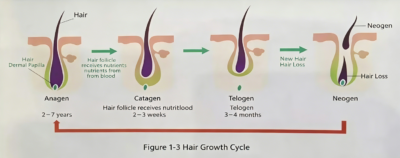
The hair growth process essentially involves four stages.
Generally speaking, each strand of hair has a lifespan of approximately 3 to 7 years. Under normal conditions, 50 to 80 strands of hair are shed daily; the rates of hair growth and loss are balanced, meaning that for every strand lost, a new one grows to replace it.
III. The three components of the hair shaft:
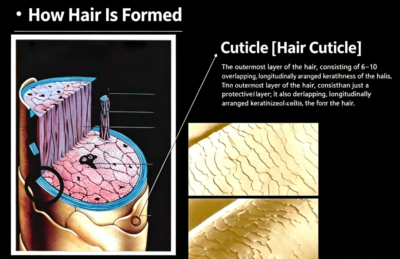
- Cuticle (Scale layer): The outermost layer of the hair, typically composed of 2–4 layers of scales. The cuticle is usually translucent or colorless, allowing the hair’s natural color to show through. Function: Protects the hair and maintains its health, flexibility, and suppleness.
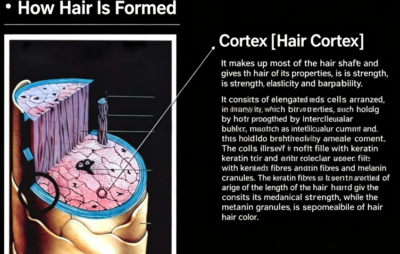
- Cortex (Organic layer): The most important part of the hair, consisting of a mass of long, parallel fibrous cells arranged longitudinally. Function: Accounts for 90% of the hair’s total weight.
Contains: 1. Factors determining elasticity, toughness, and softness; 2. Moisture: Determines the hair’s luster, smoothness, and strength; 3. Melanin pigment: Determines hair color (black, brown, red, or yellow); 4. Chemical bonds: Determine hair shape; known as the “four major bonds” (disulfide bonds, hydrogen bonds, peptide bonds, and salt bonds). Characteristics: Hygroscopic; highly resistant to chemicals but vulnerable to acids and sulfur-based compounds.
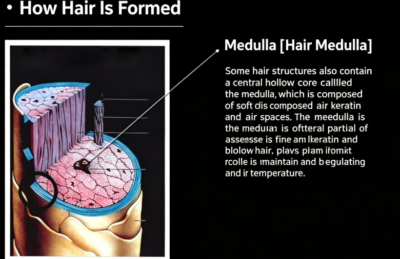
- Medulla (Air-filled core): The central core of the hair, composed of transparent, polygonal keratinized cells; it enhances the hair’s strength and rigidity and provides structural support. Characteristics: Does not transport nutrients; not all hair contains a medulla (e.g., very fine hair or vellus hair).
- Hair properties can be categorized into physical properties and chemical properties:
Physical Properties:
Hair is thicker at the root and tapers toward the tip; consequently, hair diameter varies, allowing hair to be classified as average, coarse, or fine.
- Hair shape: Hair can be classified into three types: straight, wavy, and naturally curly. The cross-section of straight hair is round, that of wavy hair is oval, and that of naturally curly hair is flattened; hair thickness is independent of whether the hair is straight or curly.
- Hair absorbency: Normal hair typically contains approximately 10% water.
- Hair elasticity and tensile strength: Elasticity refers to the hair’s ability to stretch to its maximum length and then return to its original state. A single strand of hair can stretch by approximately 40–60%; this extensibility is determined by the cortex. Tensile strength refers to the force hair can withstand before breaking; a healthy strand of hair can support a weight of approximately 100–150 grams.
- Hair porosity: Porosity refers to the hair’s capacity to absorb moisture; processes such as dyeing and perming are closely related to hair porosity.
- Thermal properties: Heat resistance is closely linked to hair properties; generally, when heated to 100°C, hair begins to undergo extreme changes, eventually carbonizing and dissolving.
Chemical Properties:
- The primary component of hair is keratin, accounting for approximately 97%; keratin is composed of amino acids.
- Asian hair is characterized by being coarse, black, stiff, and heavy; it is dark in color due to a higher content of carbon and hydrogen. Western hair is characterized by being light, soft, and fine; it is lighter in color due to a lower content of carbon and hydrogen.
- The keratin forming the hair cuticle consists of over 20 types of amino acids arranged longitudinally.